

India DLT Process
India's telecom regulators require all enterprises sending SMS traffic to comply with the Distributed Ledger Technology (DLT) framework introduced by Telecom Regulatory Authority of India (TRAI). The objective is to reduce spam, fraudulent messaging, and ensure traceability of business communications.
DLT is a blockchain-based registration and scrubbing ecosystem operated by Indian telecom operators. Before an organization can send SMS messages in India, it must register its identity, sender IDs, and message templates on a telecom operator's DLT platform.
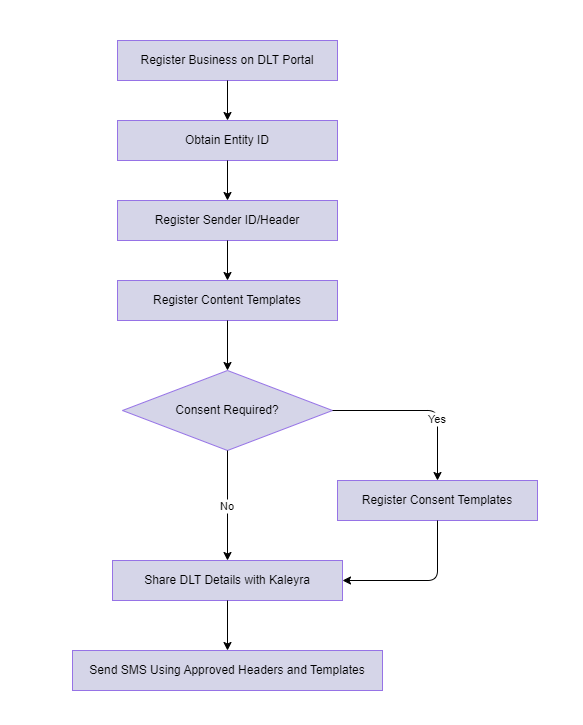
DLT Compliance Workflow
The following is the DLT compliance workflow:
Key DLT Entities
The following are the key DLT entities:
Entity Registration
The business (brand or company) must register itself as an Entity or Principal Entity on a DLT portal provided by operators such as Airtel, Jio, Vodafone-Idea, Tata, BSNL, or Videocon. After approval, the business receives an Entity ID.
Header (Sender ID) Registration
The organization registers its SMS sender name, commonly called a Header or Sender ID. This identifies the brand that appears as the sender of SMS messages.
For example: ABCXYZ, TATCOM, MYBANK, and so on.
Content Template Registration
Every SMS content format must be pre-approved and registered on DLT. Only messages matching approved templates can be delivered.
For example:
Dear {#var#}, your OTP is {#var#}. Valid for 10 minutes. The variable portions are defined as placeholders during template registration.
Consent Template Registration
For promotional or consent-based communication, businesses may need to register consent templates that define how customer permission is obtained and maintained.
India Telecom Regulations - DLT Process
To know more about the DLT process, click the respective card:
Updated 2 months ago