

The WhatsApp Direct Send Message API simplifies WhatsApp utility messaging by enabling you to send business-initiated messages without creating and managing message templates manually.
Benefits:
Direct Send streamlines the integration process, reduces template management complexity, and provides greater flexibility when template recategorization policies are enforced. This allows you to accelerate deployment of utility messaging use cases while leveraging WhatsApp as a scalable communication channel.
Note:
- The Direct Send Message API feature from Meta is currently on the beta stage. Please contact your Account Manager to enable Direct Send capability for your WhatsApp Business Account (WABA).
- The request payload must include
"category": "utility"or"category": "authentication"in the request payload.
How Direct Send Works
Direct Send automatically creates templates and matches message content against existing templates before sending.
Flow Diagram:
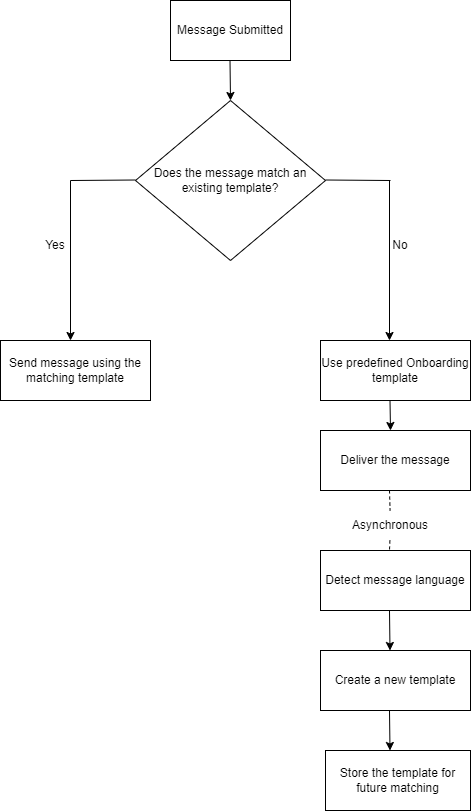
Message Processing Flow
When a message is submitted:
- Meta first checks whether the message content matches an existing template.
- If a matching template is found, the message is sent using that template.
- If no matching template exists, Meta falls back to predefined onboarding templates to continue message delivery.
- Meta then asynchronously creates a new template based on the submitted message content for future use.
Auto Template Creation
During auto template creation:
- The message language is detected automatically.
- A new template is generated and stored for subsequent matching requests.
Supported Message Types
The WhatsApp Direct Send Message API supports following message categories:
- Utility messages
- Authentication messages
enabling you to send messages of these categories without requiring pre-approved templates.
The WhatsApp Direct Send Message API support following message types:
- Text Message - Send simple text-based messages containing a message body and URLs.
Notes:
- The
preview_urlis not supported.- The URLs included in the message body will not generate rich link previews.
- Interactive button messages for Call-to-Action URL or Reply buttons (recommended)- Send interactive messages containing Call-to-Action (CTA) buttons or Reply buttons.
Notes:
- The message header must be of type
text,image,video, ordocument.- Access to image, video, and document headers may be restricted. Contact your Account Manager to enable these capabilities for your account.
When sending messages with Interactive Button, following Buttons type are supported:
(2.1). Reply Buttons
The Interactive Reply Button messages allow you to send predefined response options that end users can select directly within WhatsApp.
- Supports up to 3 Reply buttons per message.
- When an end user selects a button, a webhook notification is triggered containing the selected response.
- Mixed Buttons (Interactive button messages for Call-to-Action URL or Reply buttons)
You can combine Call-to-Action (CTA) URL buttons and Reply buttons with the same message.
- Supports up to 10 buttons in total (minimum one of each kind).
- Supports a maximum of two CTA URL buttons.
- CTA buttons are always displayed before Reply buttons.
This page contains the following topic: